
Tokyo, 1964: the watch that looked at the world
Seiko timed the first Games held in Asia with quartz clocks that did not yet exist on any wrist, and launched for the occasion a watch with the cities of the world on its dial.
On 29 May 1959 Tokyo learned that it would host the 1964 Olympic Games, the first in Asia. Japan was emerging from the postwar years and wanted to prove something. Seiko, then a large company in Japan and almost unknown outside it, decided that this something had to include the official timekeeping. It had never timed an international competition.
Seventeen months
The Olympic technical committee met in Belgrade in September 1962 and took a provisional decision in favour of Seiko. Official confirmation came in May 1963, with the Games seventeen months away. The committee put in writing that it was not choosing a Japanese manufacturer because the Games were in Tokyo, but because its chronometers were real instruments, backed by sound theory. It is a sentence worth remembering when someone says that Seiko "copied" the Swiss.
Nobody else had what Seiko took to Tokyo. The Crystal Chronometer QC-951, the world's first portable quartz clock: it ran on batteries, without alternating current, and had a daily error of two tenths of a second. With it came a digital quartz chronometer for the finishes, a marathon timer and a giant clock for judo, which was making its debut as an Olympic sport. For the first time, all the major events of a Games were timed with quartz. The quartz wristwatch, the Astron, was still five years from arriving; in 1964 quartz was a laboratory technology that Seiko took out onto the track.
Two watches for the occasion
To accompany the Games, the company launched two wristwatches that are benchmark pieces today. The first, the Crown Chronograph with calibre 5719 and a single pusher: the first Japanese wrist chronograph. The second, the one that concerns us here, the Seiko World Time, reference 6217-7000: the first Japanese watch with a 24-hour hand and a city scale. "To know the time anywhere on earth, instantly," the advertising said.
It is a 37 mm steel watch, with the 6217A automatic movement of 17 jewels and a crown at four o'clock with three positions: the first turns the inner city ring of 24 cities, the second changes the date, the third sets the time. The 24-hour hand has a step, a kink near the tip, so that it passes over the indices without touching them. It is an engineering detail that became its identifying mark. Those made for the Games carry the Olympic flame on the case back; those from 1965 onwards do not. And calibre 6217 is the same one that a year later, in reference 6217-8000, powered Seiko's first diver's watch, the 62MAS.
The World Time stayed in the catalogue for years with new generations and calibre 6117, changing its case and its dial but not its idea.
What Tokyo changed
For Seiko, everything. The Games gave it international technical reputation, export orders multiplied, and in 1969 it was able to put the world's first quartz wristwatch in a Tokyo shop, on a 25 December. For today's vintage buyer, Tokyo 1964 marks the moment when a Seiko stopped being "a Japanese watch" and became a Seiko.
And there is something else we like about this story. The commemorative watches of 1964 are pieces made for the Japanese market, the JDM that collectors look for so much today: more careful production runs, better finishing than the export ones and a precise historical context. It is not that they are worth more for being rare; they are worth more because they tell you something.
What to look at in a World Time
The city ring must turn with its crown without skipping steps. On the 6217-7000, the 24-hour hand must be the original, with its step; replacement ones are usually straight. And its dial comes in two original tones, silver and grey, the grey considerably scarcer. The case back tells the date: on Seikos of this period the first two digits of the serial number give the year and month, and an Olympic flame, if present, confirms 1964. And as with every automatic Seiko of the sixties, you check that the rotor does not rub against the case back and that the date changes cleanly at midnight.
In the vitrine
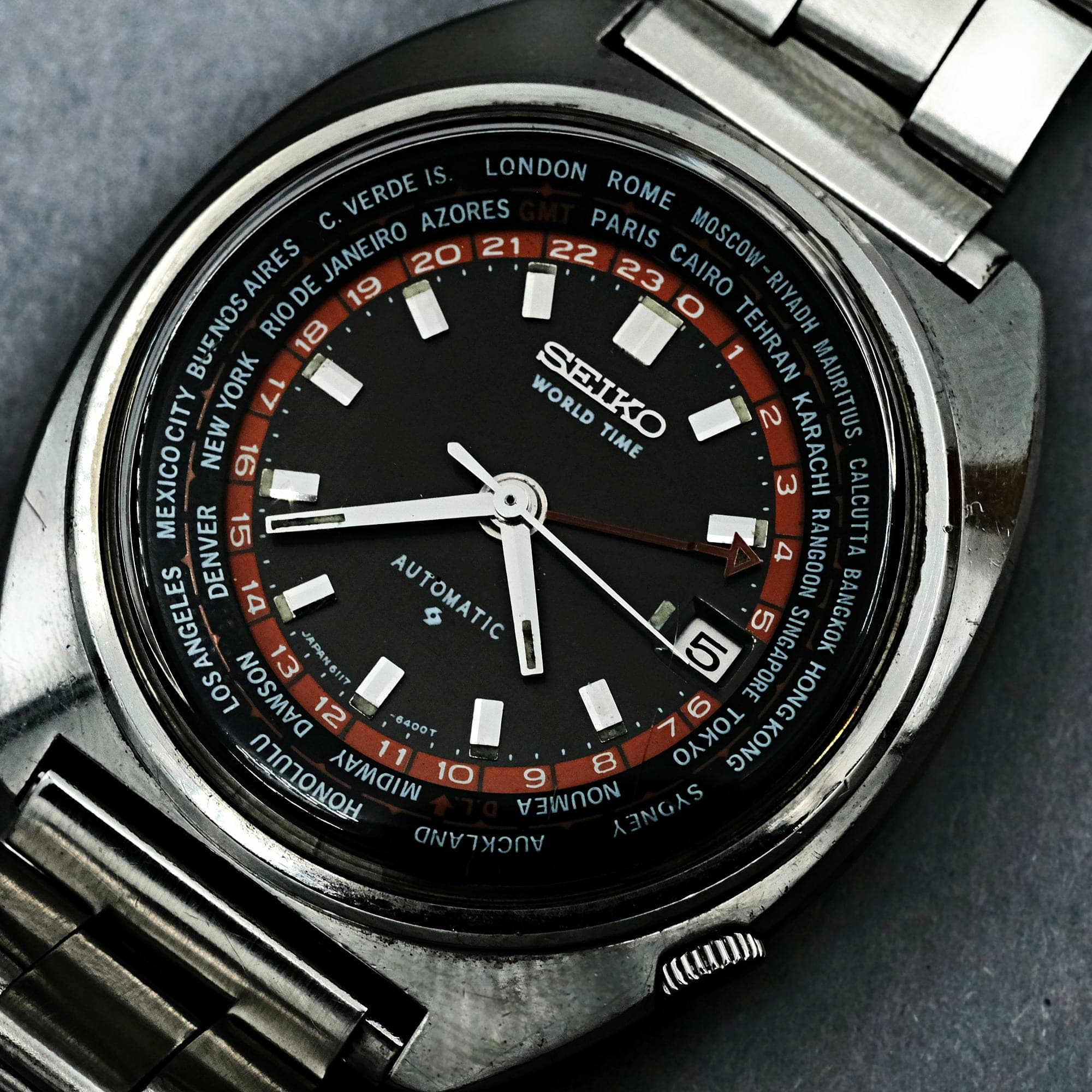
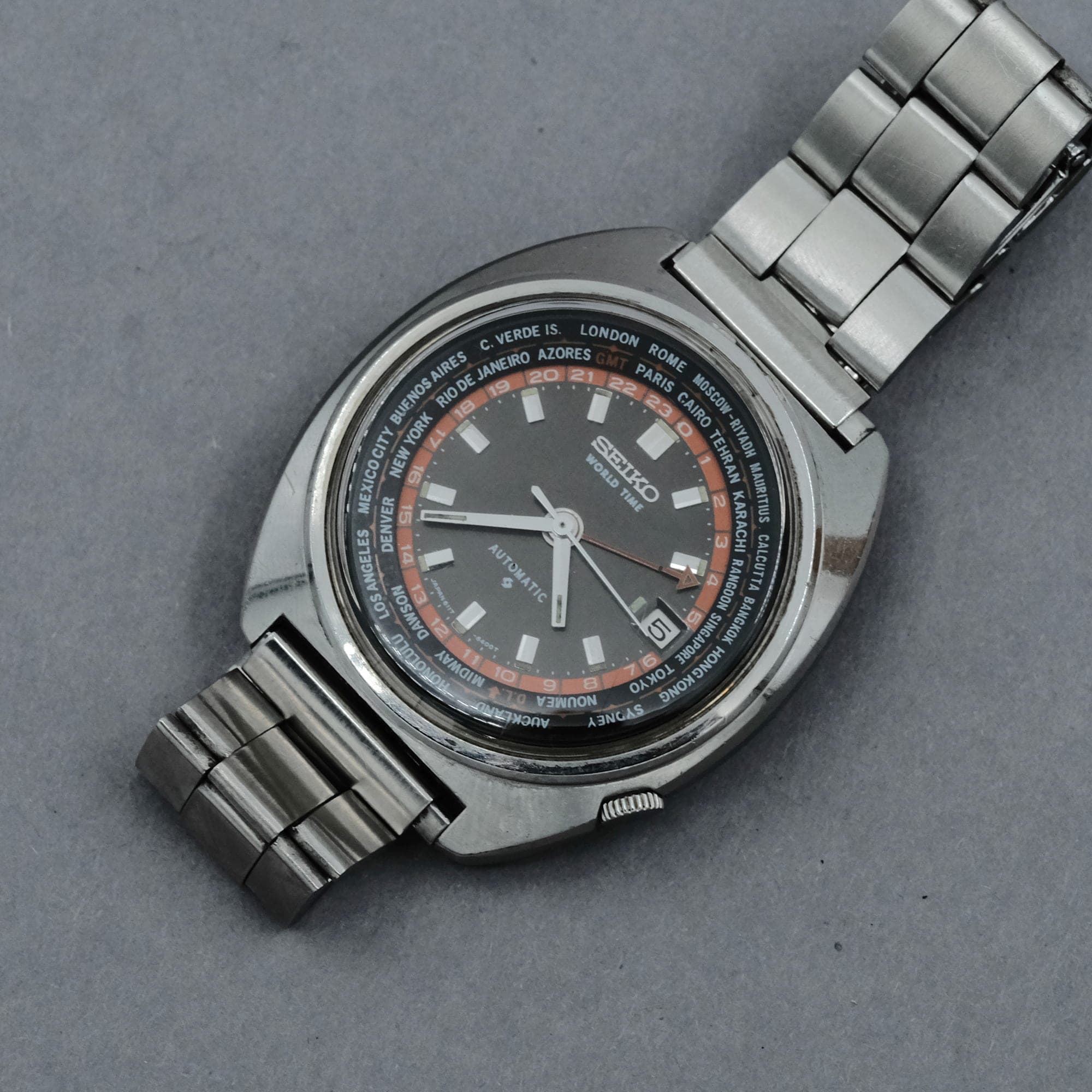
We have a Seiko World Time from around 1970, reference 6117-6400, with the 17-jewel Seiko 6117 automatic movement: one of the World Times that came after the 1964 model, from the calibre 6117 generation. Black dial, red and black 24-hour scale, and a clean city ring. It is one of those watches you understand better when you know who made it and what for.
The piece in this article
About the brand
Cartas sobre relojería, de tanto en tanto.
Sin spam. Baja cuando quieras. Privacidad.