
Refinished dials: how to recognise a redial
A refinished dial is not a fraud if it is declared. The problem is when it is not. What to look at, with a loupe, before paying for an original dial.
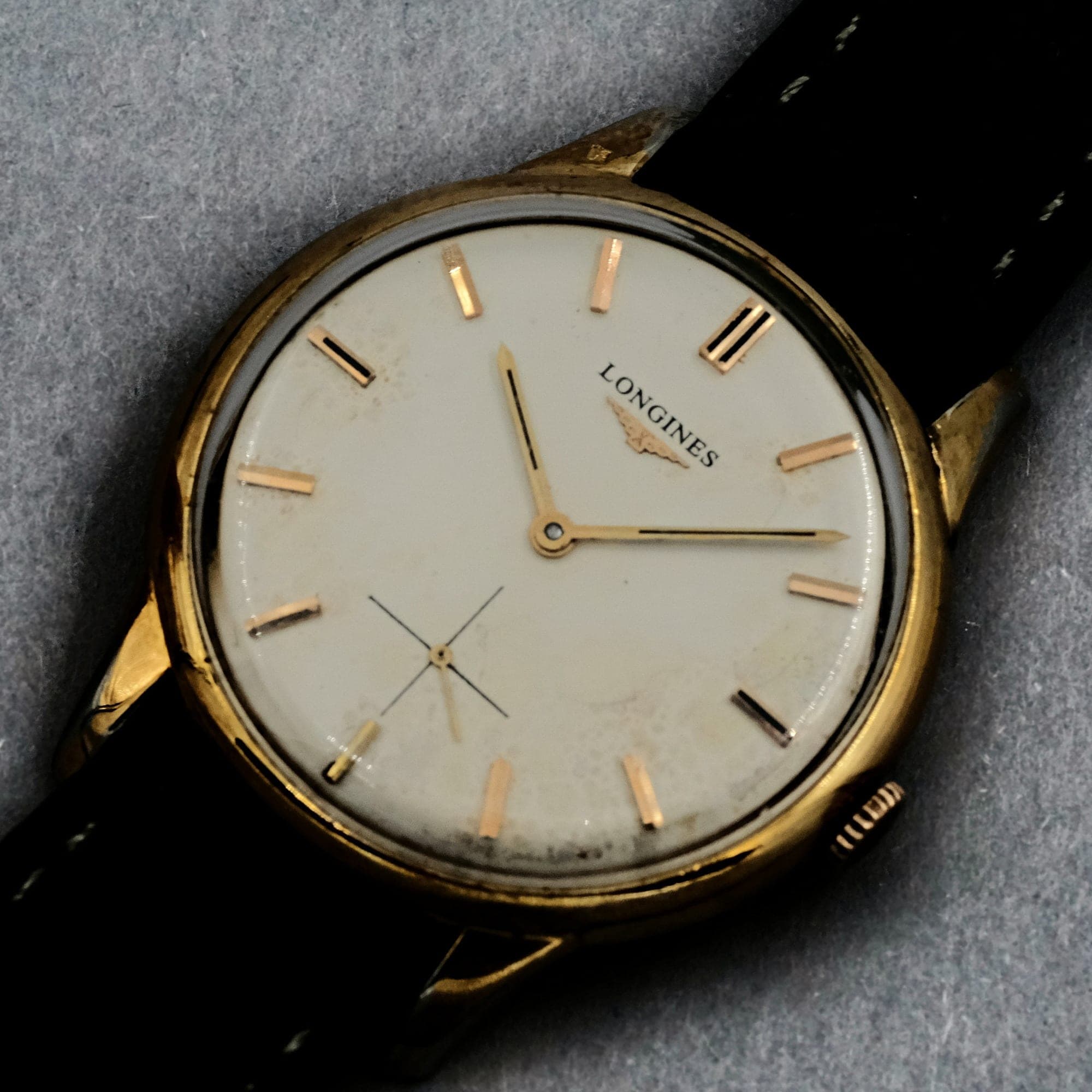
On the dial of the Longines we have in the vitrine at the moment there are marks. A pale mottling that gathers at the edges and in the lower half, and that passes beneath the fine cross of the small seconds without breaking it. The first thing many people think on seeing a dial like this is to restore it. The first thing we do is look at how it has aged, because that is what tells you whether the dial is the one that left the factory. A repainted dial, what the market calls a redial, wipes out precisely those clues.
What a redial is and why it matters
Refinishing a dial means stripping it and printing it again, or painting it by hand, so that it looks new. Many of the watches that reach us have at some point been through a workshop where the customer left a stained dial and collected a clean one. Whoever asked for it was not trying to deceive anyone, and nor was whoever did it.
The problem comes when the watch is sold. SwissWatchExpo, an American dealer in pre-owned watches, sums it up like this: a restored dial is acceptable if the work was done by a professional, if the seller declares it and if the watch is not an especially rare or historic piece. But it adds what everyone knows at an auction: all-original watches always fetch more, and a restoration wipes out part of the watch's history. An undeclared redial is, therefore, a watch sold for more than it is worth.
The printing
The underlying difference lies in manufacture. Original dials were printed in the factory, and refinished ones are almost always done by hand. That leaves a trace in the typography.
What to look at is consistency: typefaces and spacing that do not vary from one numeral to the next, crisp minute tracks and markers, no incorrect numbering. The logo and the brand name are best compared with original dials from the same period, because fonts change slightly from one year to the next. Under a loupe you can also see the proportion and alignment of the logo, the minute track and the markers. Specialists in vintage Omega stress the same thing: the font of the logo, the font of the model name, the markers and the overall quality of the dial are the first points to check.
The missing text
There is one detail that gives away many cheap redials: the "SWISS" or "SWISS MADE" inscription at six. Most ordinary refinishers do not take the trouble to put it back. A dial from a Swiss watch of the fifties or sixties without that inscription is not necessarily fake, but it calls for a closer look.
Luminous material and finish
On dials with luminous material, it must be consistent between markers and hands. Aged tritium does not glow brightly or for long, and its colour leans towards yellow or brown, not white or neon green. Fresh luminous material on a dial supposedly from 1965 is a clear sign.
The finish counts too. Original dials oxidise and lose their gloss over time; a very strong gloss may indicate that the dial has been redone.
Everything telling the same story
The simplest check needs no loupe. A perfect dial on a watch with a heavily worn case is the first warning sign. A watch ages as a whole: the case, the crystal, the hands and the dial. When one of the parts looks as if it came from another decade, it is worth asking why.
None of these signs is proof on its own. There are original dials exceptionally well preserved and refinished ones very well done. What gives confidence is several signs pointing the same way, and a seller who says clearly what they know and what they do not. Vintage Masters sums it up with the saying everyone who has been at this for years repeats: buy the seller, not the watch.
What our Longines shows
With that in mind, the Longines reads well. The winged hourglass logo is an applied gilt part, not printed, and the name "LONGINES" is printed in black with a clean stroke. The cross of the small seconds is fine, of constant thickness, and ends in a square cut. The mottling affects the background and the printing alike, with no cleaner areas around the letters. The applied markers, faceted and gilt, are of a set with the hands. And the dial has aged at the same pace as the case, gold-plated and lightly worn.
All of that is consistent with a dial nobody has repainted. It is not absolute certainty: without taking the watch apart you cannot see the back of the dial, and we say so. But it is exactly what is lost in a redial, and the reason we are not going to clean it.
In the vitrine
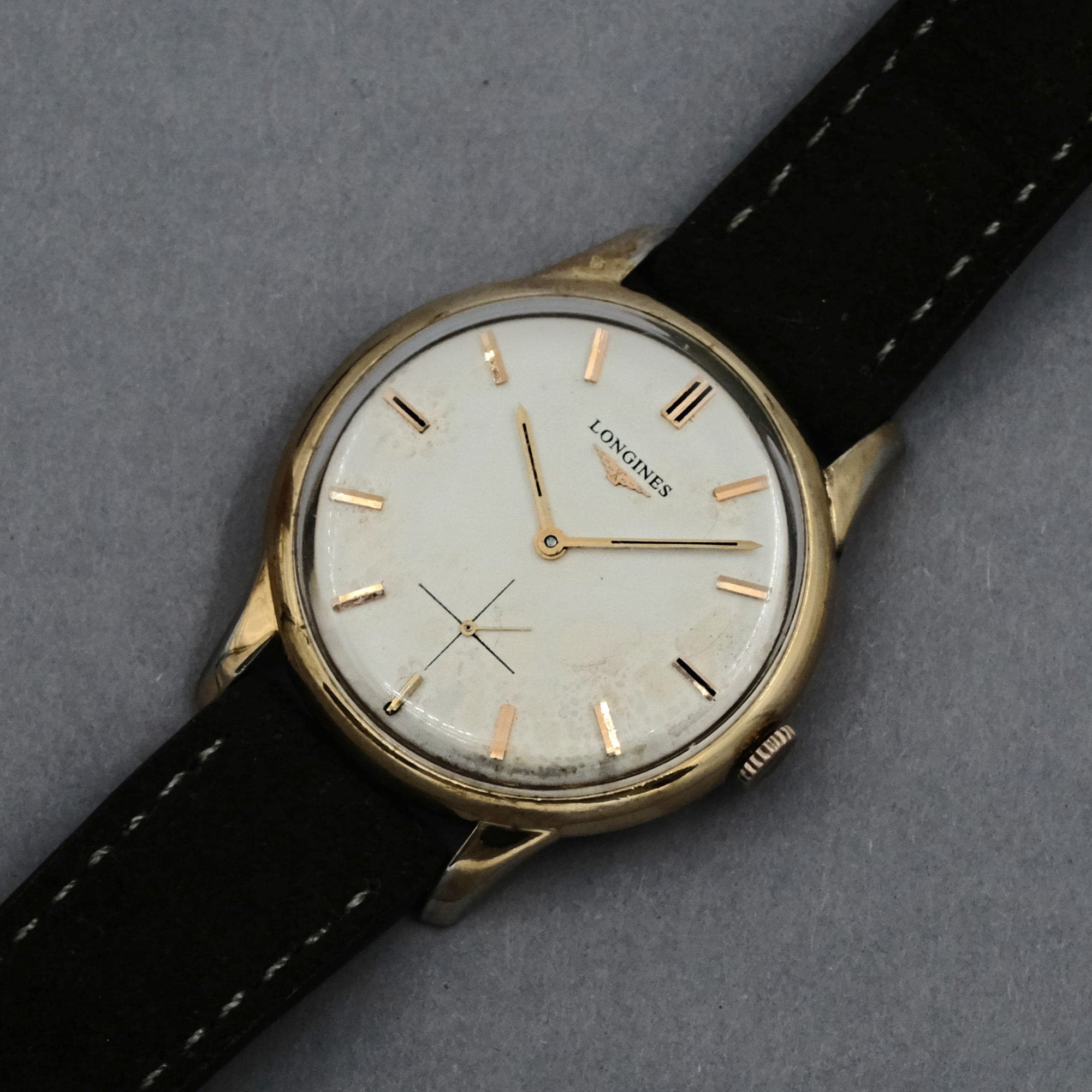
We have the Longines with small seconds, hand-wound and from around 1960, in a gold-plated case with steel back. The dial is as you see it, with its mottling at the edges, and the listing says so. If you have a watch and you have doubts about its dial, send us photos straight on and close up: it is one of the questions we most enjoy answering.
The piece in this article
About the brand
Cartas sobre relojería, de tanto en tanto.
Sin spam. Baja cuando quieras. Privacidad.