
The tropical dial: when damage is worth more
A black dial that the sun has turned brown can be worth more than an untouched one. A dial that has broken out in stains is not always. Where the line falls, with a Tissot Seastar on the bench.
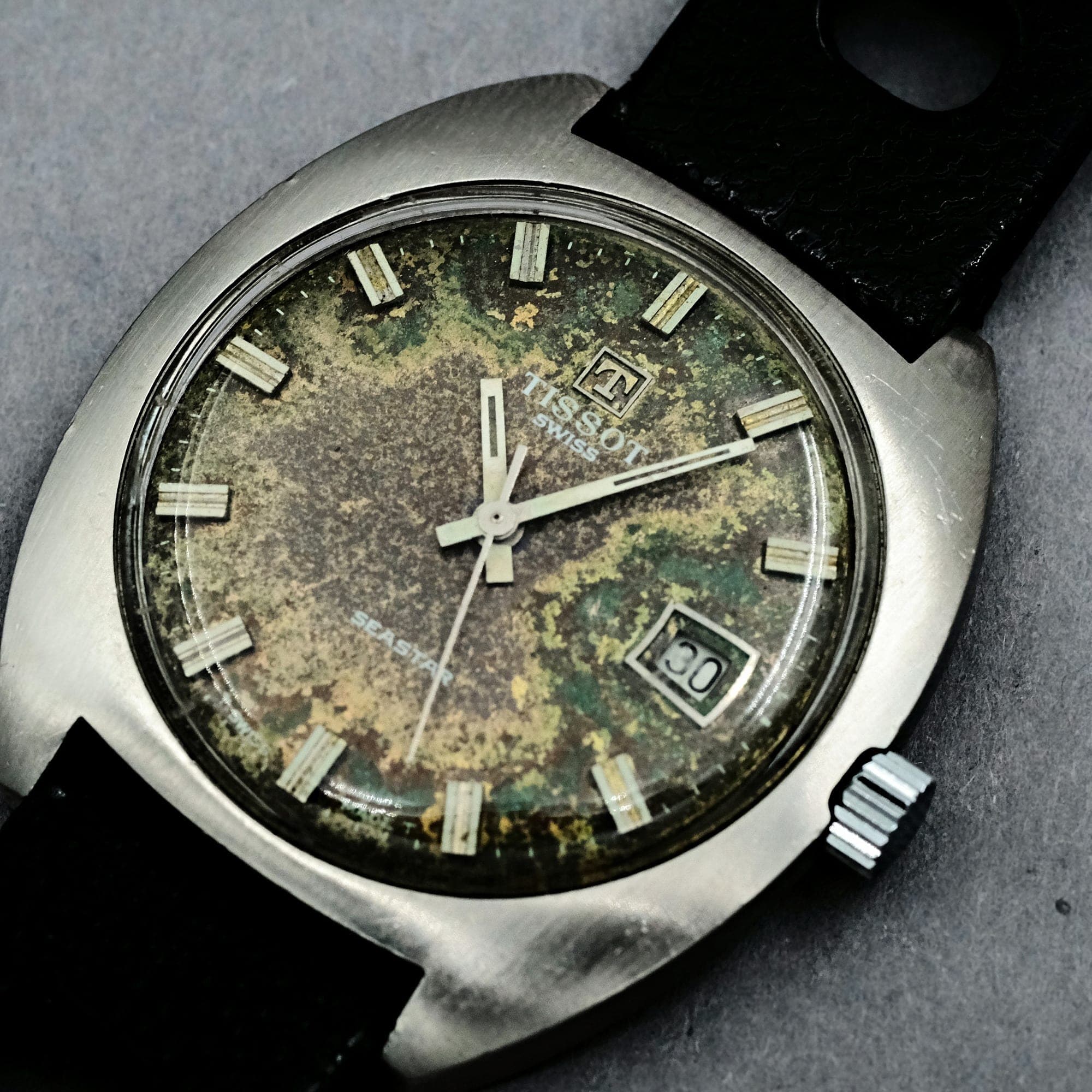
The Tissot Seastar we have in the studio left the factory, around 1970, with a black dial. It is not black today. Under the lamp you can see green islands, ochre stains and areas where the black holds out, scattered without order across the whole surface. On top of it, the printing is still in place: the T logo, "TISSOT SWISS", "SEASTAR" and the date window at three with its frame. Some would call it tropical and some would call it a damaged dial. Both have a point, and it is worth explaining why.
What a tropical dial is, strictly speaking
In collectors' language, a tropical dial is a black dial that has turned brown over the years. The cause is ultraviolet light. The paints and lacquers used on dials in the mid-twentieth century were not made to withstand it, and some shifted towards brown with exposure to the sun. Pure carbon black stands up well to UV, so the change is put down to unstable additives in the mix. Michael Young, a watch restorer, explained it in 2018 on aBlogtoWatch: some Swiss dial suppliers used a paint with a manufacturing defect that made it less resistant to light than was believed.
Not every exposed dial changed. The same restorer estimates that, of the watches that could have turned tropical, roughly one in ten did. And not every change is good: too much sun lightens the black to a pale brown that most collectors do not like. The point people look for is a warm, chocolate brown, and above all an even one.
Interest in these dials is relatively recent: the term began to carry weight among collectors in the 2000s, and since then some brands have imitated the effect on new watches, to the point of reproducing small water spots on the dial.
Why it can be worth more
Because of scarcity and history. A tropical dial is the result of a combination of conditions that cannot be planned: a particular paint, years of sun and, afterwards, the watch surviving without anyone swapping the dial for a new one. Many dials like this were replaced during services, because at the time they were seen as a defect. Few are left.
On the watches the market moves most, the difference is large. The usual example is a Rolex Submariner 5513: around 20,000 dollars with a normal black dial and easily 30,000 with an attractive tropical one. On mid-priced watches the premium exists, but it is much smaller and depends on the buyer.
Where damage begins
This is the important part. Rolex Passion Market, a site specialising in vintage Rolex, distinguishes between a change of colour caused by light and what water does. On a true tropical dial, light has changed the colour, the luminous material is intact and the surface keeps its gloss. When water gets in, with salt or chlorine, the lacquer breaks down and the luminous material is destroyed: that is not tropical, it is damage. And when the lacquer cracks, it comes away and takes the printing with it.
There is something else to know before paying for a patina: a genuinely aged dial keeps changing unless it is carefully preserved. One that is at its best today may be past it in a few years. Details such as adhesive showing beneath an applied marker or luminous material crumbling on the hands make a dial unique, but deterioration can also go too far.
The practical check is the one we do ourselves. Tilt the watch under a light and look at whether the change of colour is even or in patches, whether there are cracks or flakes in the lacquer, whether the printing is complete and whether the luminous material on the hands and markers is consistent between them.
What our Seastar has
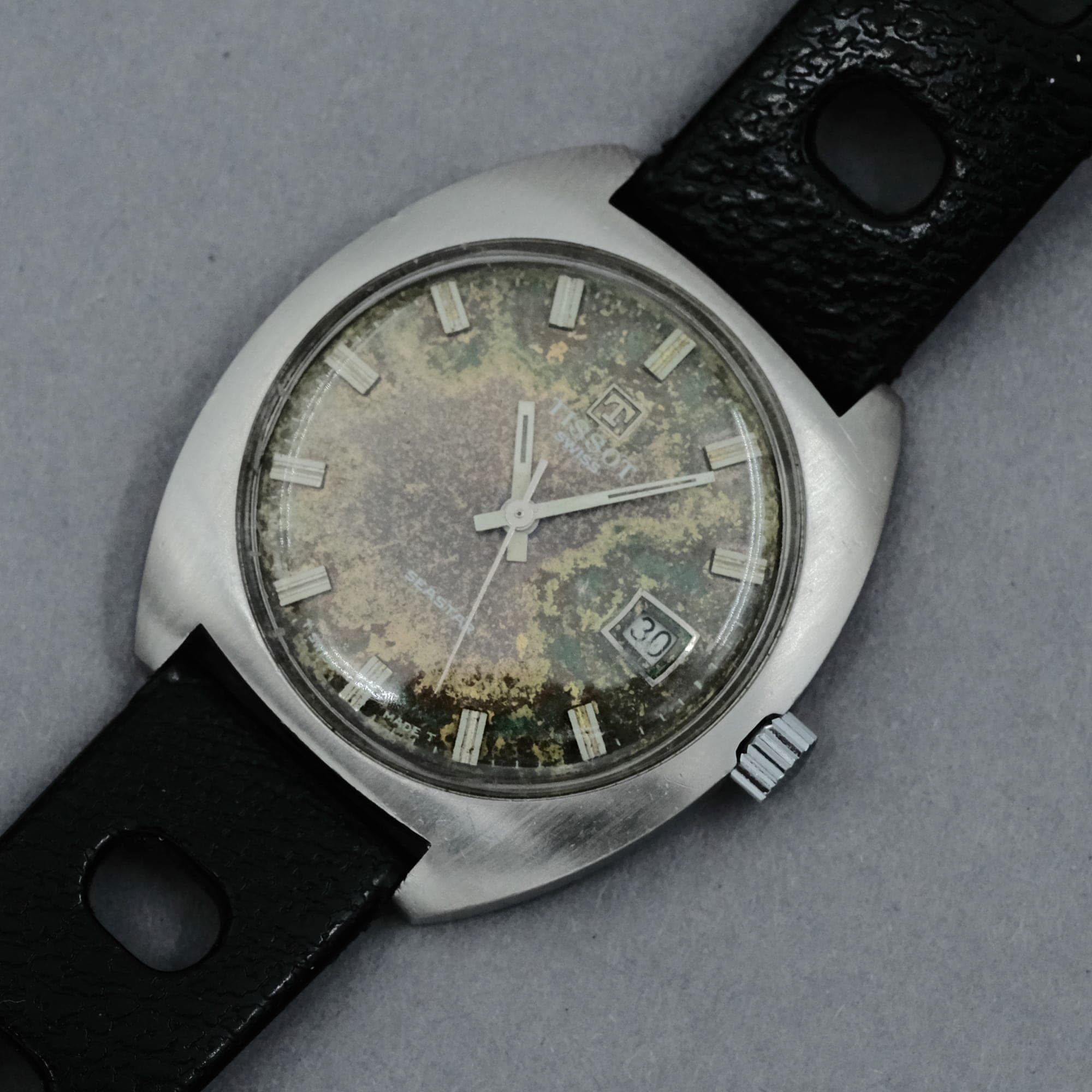
We will say it as it is. The dial of this Seastar is not a textbook tropical. There is no even brown but an extensive breakdown of the lacquer, with green and ochre areas spread across the whole surface. What it does keep is the printing, legible from end to end, and the applied markers, complete and in place. It is what we call in the listing a piece for a patina collector.
The difference matters for the price. The premium the market pays is for the even brown that light has left, with the lacquer and the luminous material intact. Lacquer that has broken down into patches falls, by that standard, into the territory of damage, and there no premium applies: the watch is worth what its case and its movement are worth, and whatever that dial says to each buyer. And it has to be borne in mind that lacquer in this state is not standing still. It may go on changing, and nobody can promise in which direction.
Some find it the most interesting dial in the vitrine; others see a watch that ought to be redialled. Both positions are legitimate, and that is why its price carries no premium for "tropical". If someone decides to change its dial, the watch becomes a different one, and it should be declared as such when sold.
In the vitrine
We have the Tissot Seastar with tropical dial, from around 1970, with date at three. Its listing describes the dial as it is, with close-up photos from several angles. If patina interests you, it is worth seeing in the hand: under the lamp it changes more than any photo shows.
The piece in this article
About the brand
Cartas sobre relojería, de tanto en tanto.
Sin spam. Baja cuando quieras. Privacidad.