
The first watch that would not scratch
In 1962 a small factory in Lengnau showed a watch in Basel with a tungsten carbide case and a sapphire crystal. It called it DiaStar. Sixty years on, it still has not got a scratch.
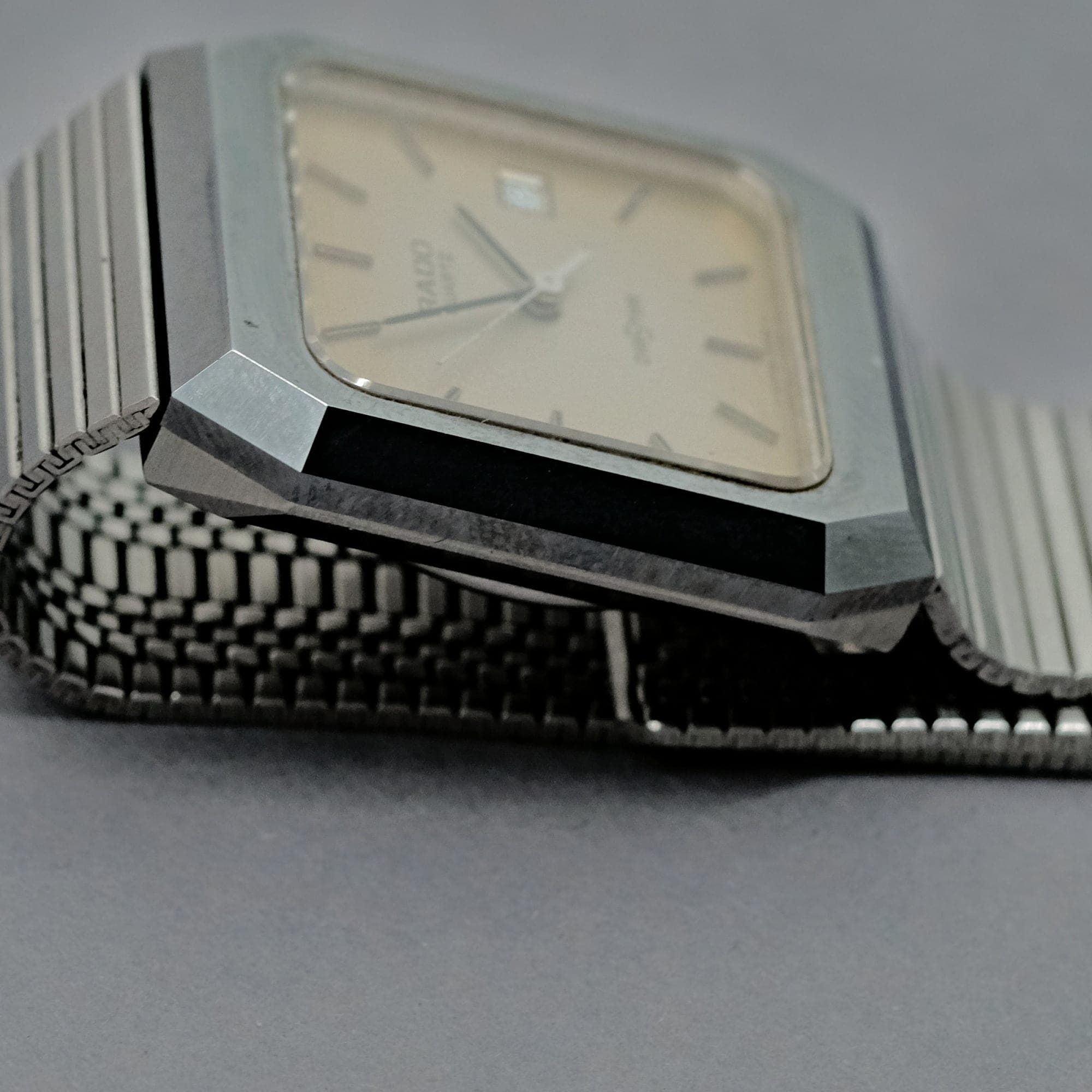
There is a test we do on almost every watch that comes into KLASSE, and on a Rado DiaStar it is of no use: tilting it under the lamp to count the marks of wear. There are none. On a watch from 1975 with forty years on the wrist, the edge of the case shines as it did the day it left the factory. It is not a miracle or a restoration. It is tungsten carbide, and it is the reason Rado exists as we know it.
A calibre factory that wanted to do something else
Rado was born in 1917 in Lengnau, near Biel, as Schlup & Co., a movement factory founded by the brothers Fritz, Ernst and Werner Schlup. For decades it did not sell watches under its own name: it made calibres for others. It registered the Rado brand (in Esperanto, "wheel") in the twenties, but did not use it in earnest until 1957, when it launched its first collection of its own, the Golden Horse, and stopped making movements in order to fit those of suppliers such as A. Schild.
The "horses" series is what fixes the identity of the house: Golden Horse, Green Horse (its first water-resistant model, from 1958), Silver Horse, Purple Horse. Steel watches, automatic, with many rubies on the dial as a selling point, two seahorses applied at six o'clock and, from those years on, the detail that still tells a Rado from two metres away: a pivoting anchor mounted on a red synthetic ruby, which turns freely with the movement of the wrist. It serves no purpose. That is exactly why people like it.
Three years of development and a patent
At the end of the fifties, the house set itself a goal that sounds like advertising but was an engineering problem: a watch that would last longer, shine more and outlast almost any other on the market. The answer was material, not mechanical. For the case, a tungsten carbide alloy they christened "hardmetal": a hardness of between 1,400 and 2,000 Vickers, when a case-grade stainless steel stays at around 200. For the crystal, synthetic sapphire, almost as hard as diamond, at a time when acrylic was the norm.
On 28 November 1961 Rado patented the use of hardmetal in watch cases and became the first brand to combine it with a sapphire crystal. In April 1962, at the Basel fair, it presented the result: the DiaStar, "the world's first scratch-proof watch". The name joins diamond and star, for the hardness and for the shine. The case, a sort of flattened oval with a round dial, looked like nothing else. Success came first in Asia and then, more slowly, in the rest of the world.
What the brochure did not say
Hardmetal does not scratch, but it is brittle. A sharp knock on an edge can break off a chip, and a chip in tungsten carbide is not polished out: it stays. Sapphire does not scratch either, but it can break, and the faceting of the original DiaStars is not replaced with a generic part. And a case that does not scratch cannot be re-polished either: what it has is what there is. In practice this is good, because it means a DiaStar from the seventies is either preserved perfectly or clearly shows what has happened to it. There is no middle ground and no disguised restorations.
There is something else worth saying. Rado made a great many DiaStars: automatics with AS and ETA calibres in the sixties and seventies, quartz from the end of that decade, with date, with day and date, in silver finish and in gold finish, with and without diamonds. They are not all the same, and on the period ones the calibre matters less than the condition of the crystal and the edges.
Why a vintage Rado is worth it
Because it is one of the few Swiss brands whose most important watch went on sale in 1962 and is still in the catalogue, and because the ones from the period can be bought for a fraction of what the new ones cost. And because the obsession with materials that began with hardmetal ended, in 1986, in the high-tech ceramic of the Rado Integral and in everything that came after. Whoever wears a 1972 DiaStar wears the beginning of that story, without scratches.
In the vitrine
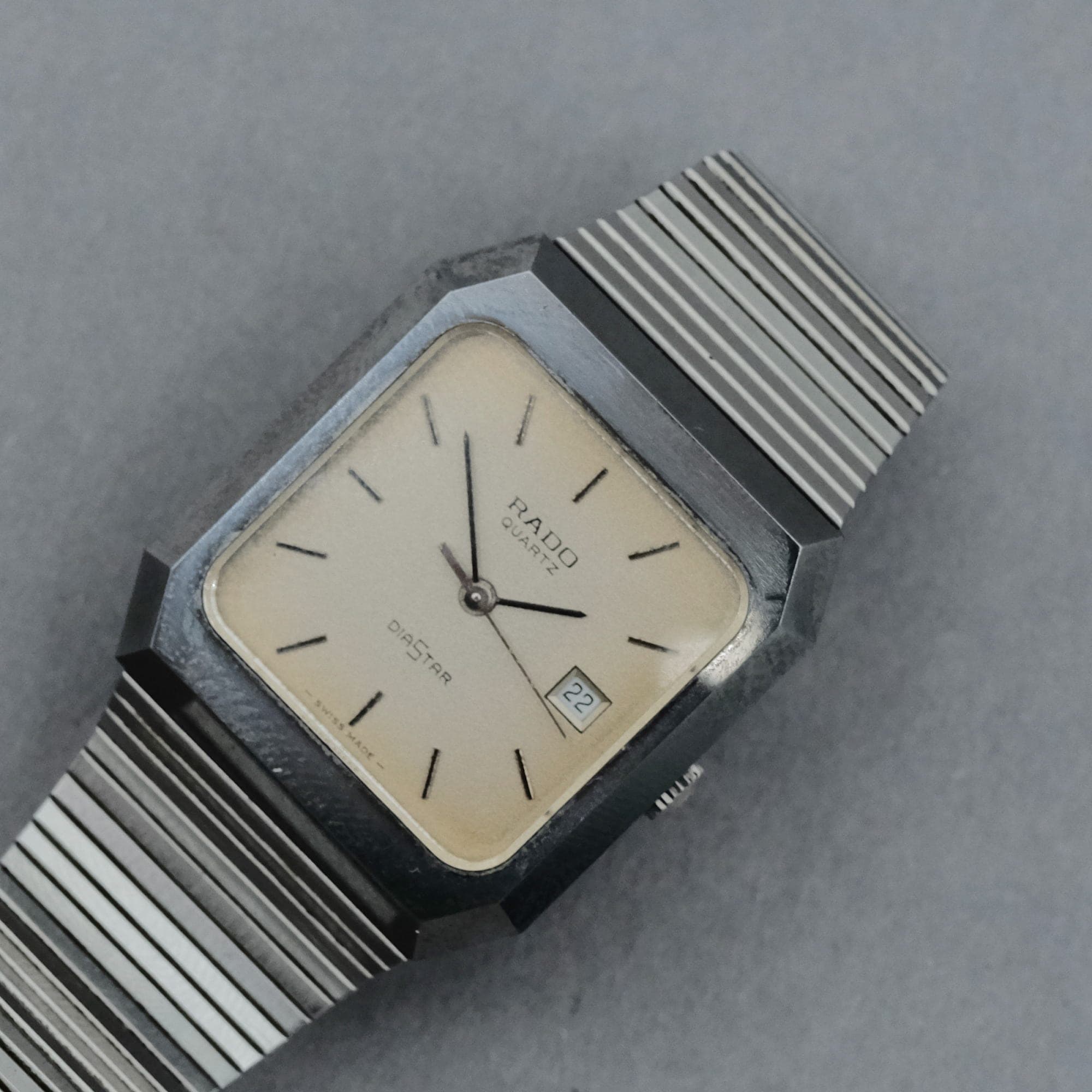
We have a Rado DiaStar Quartz from around 1980, quartz with the date at 4:30, a champagne dial and a square case in tungsten carbide and steel, and a Rado Purple Horse from around 1975, an automatic with day and date, reference 636.3476.4. If you come by the studio, ask to see them under the lamp.
The piece in this article
About the brand
Cartas sobre relojería, de tanto en tanto.
Sin spam. Baja cuando quieras. Privacidad.