

The First Watch in Space: The Secret History of Poljot and the Soviet Cosmonauts
From Moscow to the Stars: How the USSR Built Its Own Precision Chronographs
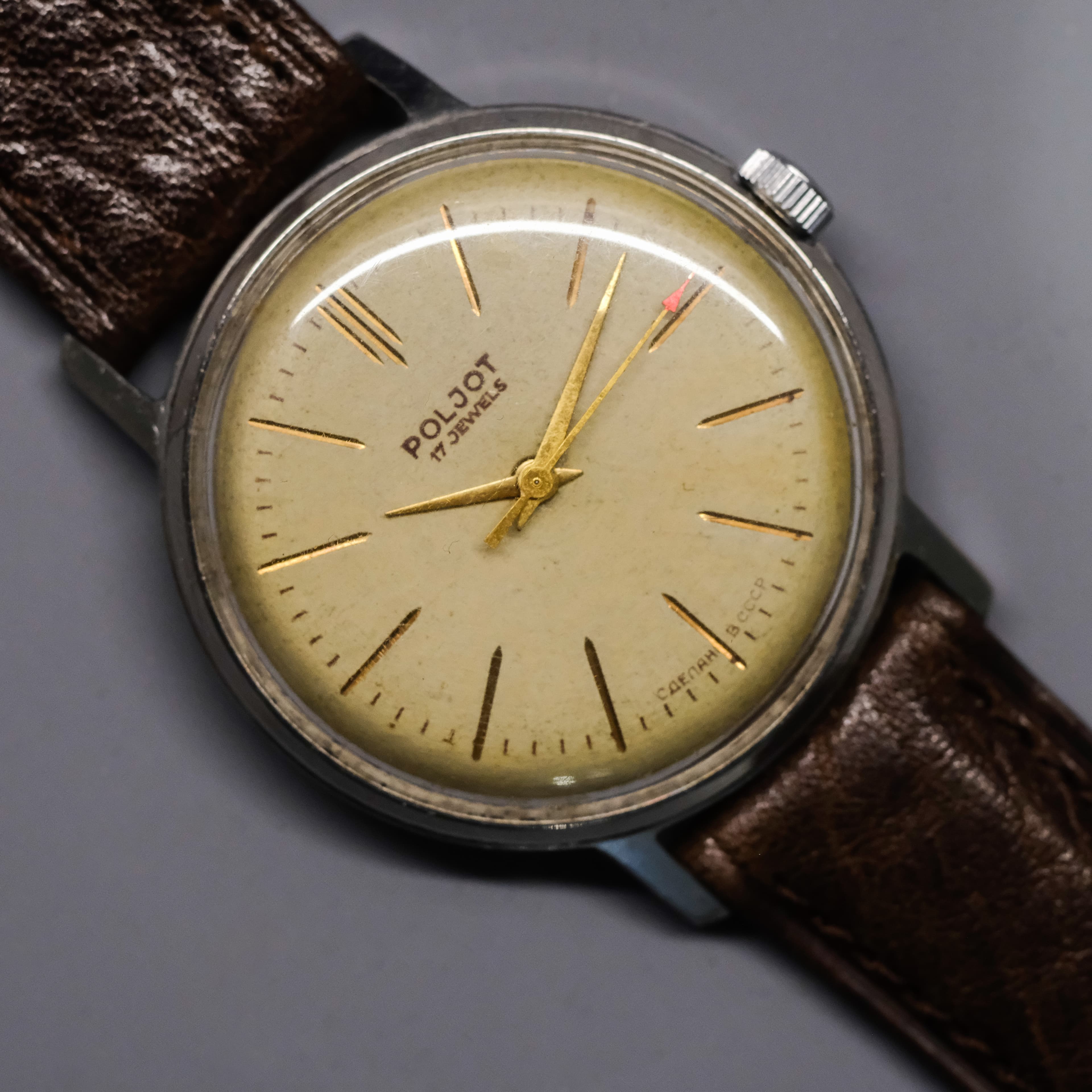
On April 12, 1961, while Yuri Gagarin completed humanity's first orbit around Earth, a small 33-millimeter watch marked the most important 108 minutes in space history. It wasn't Swiss. It was Soviet: a Sturmanskie produced by Poljot, the First Moscow Watch Factory. This article explores the fascinating history of Soviet watchmaking, from its origins with American machinery purchased in 1929 to the legendary chronographs that accompanied cosmonauts into space. You'll discover why these watches, designed to withstand extreme conditions, are experiencing a renaissance among Western collectors who value their robustness, history, and mechanical honesty
108 Minutes That Changed Everything
“Poyekhali!” — Let’s go!
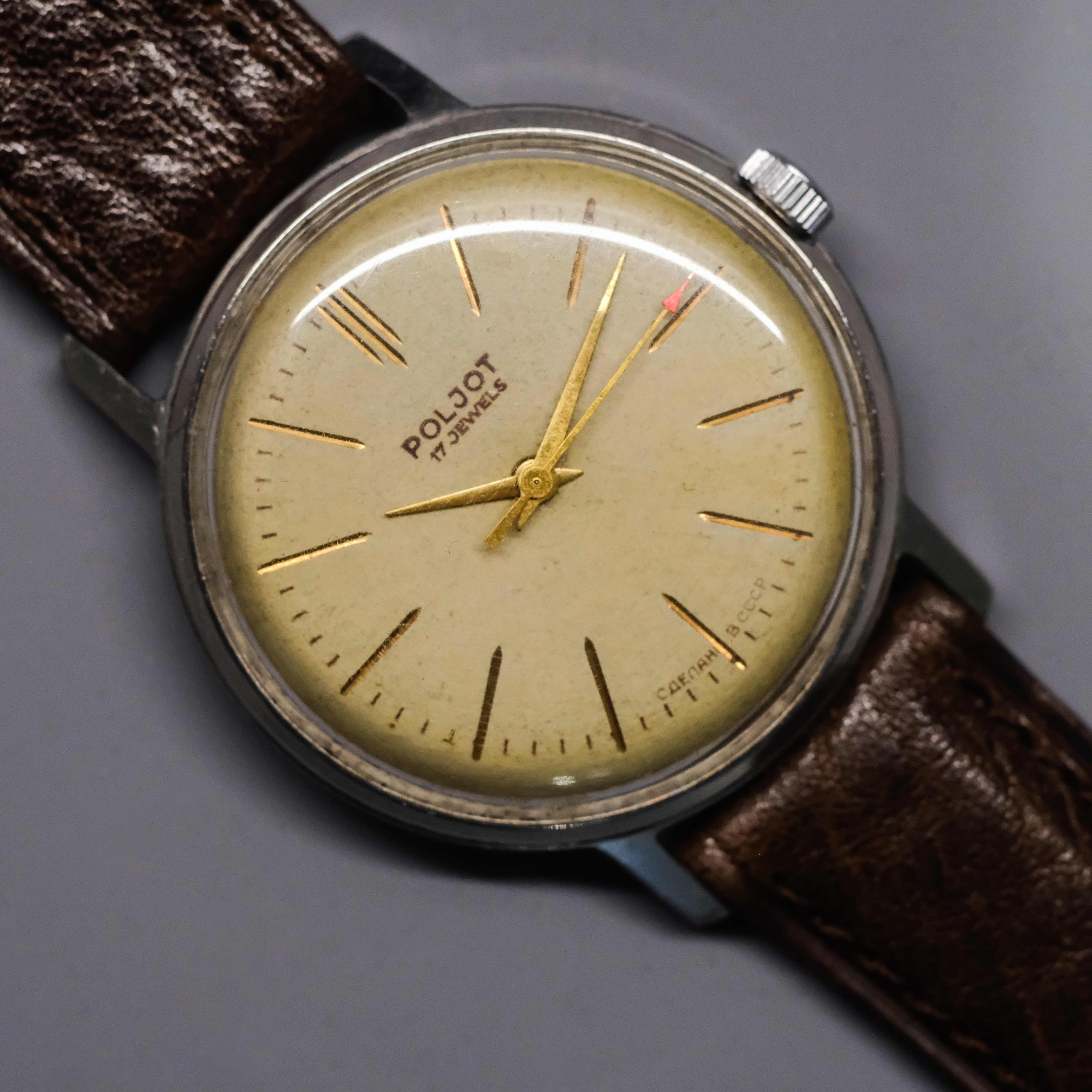
With that single word, Yuri Gagarin launched from Baikonur at 9:07 AM on April 12, 1961. During the following 108 minutes, while the Vostok 1 capsule completed one orbit around Earth at 27,400 kilometers per hour, the Soviet cosmonaut wore an instrument strapped to his wrist that few outside the space program knew existed: a manual-wind Sturmanskie watch with a 43M caliber and 17 jewels.
It wasn’t a luxury watch. It had no sapphire crystal or gold case. It was a tool: 33 millimeters of chrome-plated brass, a black dial with radium luminous paint, and accuracy of ±30 seconds per day. Enough to synchronize maneuvers where every second mattered.
That day, while the West celebrated its Swiss chronometric precision watches, the Soviet Union demonstrated that its factories could produce instruments capable of functioning where no human had gone before.
From Ohio to Moscow: The American Origins of Soviet Watchmaking
Poljot’s story doesn’t begin in Switzerland, as one might expect, but in Canton, Ohio.
In 1929, with the Great Depression hitting American industry hard, the Dueber-Hampden watch company declared bankruptcy. The Soviet government, under Stalin’s First Five-Year Plan, saw an opportunity: to purchase machinery, equipment, and technical documentation to establish a national watch industry.
Twenty-eight railroad cars transported presses, lathes, and tools from the United States to Moscow. Twenty-three American technicians accompanied the shipment to train Soviet workers. On October 1, 1930, the First State Watch Factory produced its first 50 units.
The earliest movements still bore the engraving “Dueber-Hampden, Canton, Ohio, USA.” Today, those pieces are collector’s treasures: machines that tell the story of how technology travels without ideological passports.
Poljot: Flight as Identity
For three decades, the Moscow factory operated under different names. But April 12, 1961 changed everything.
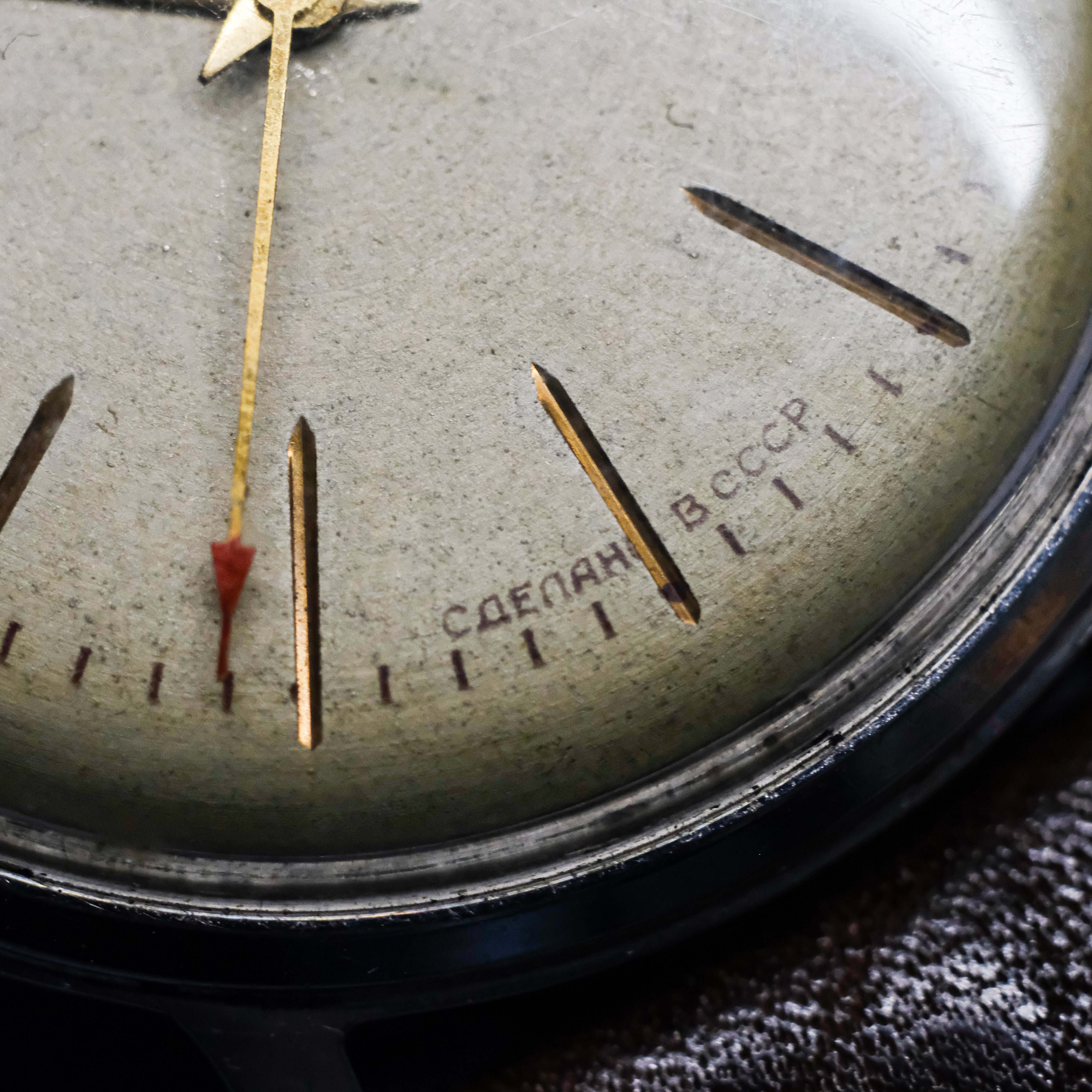
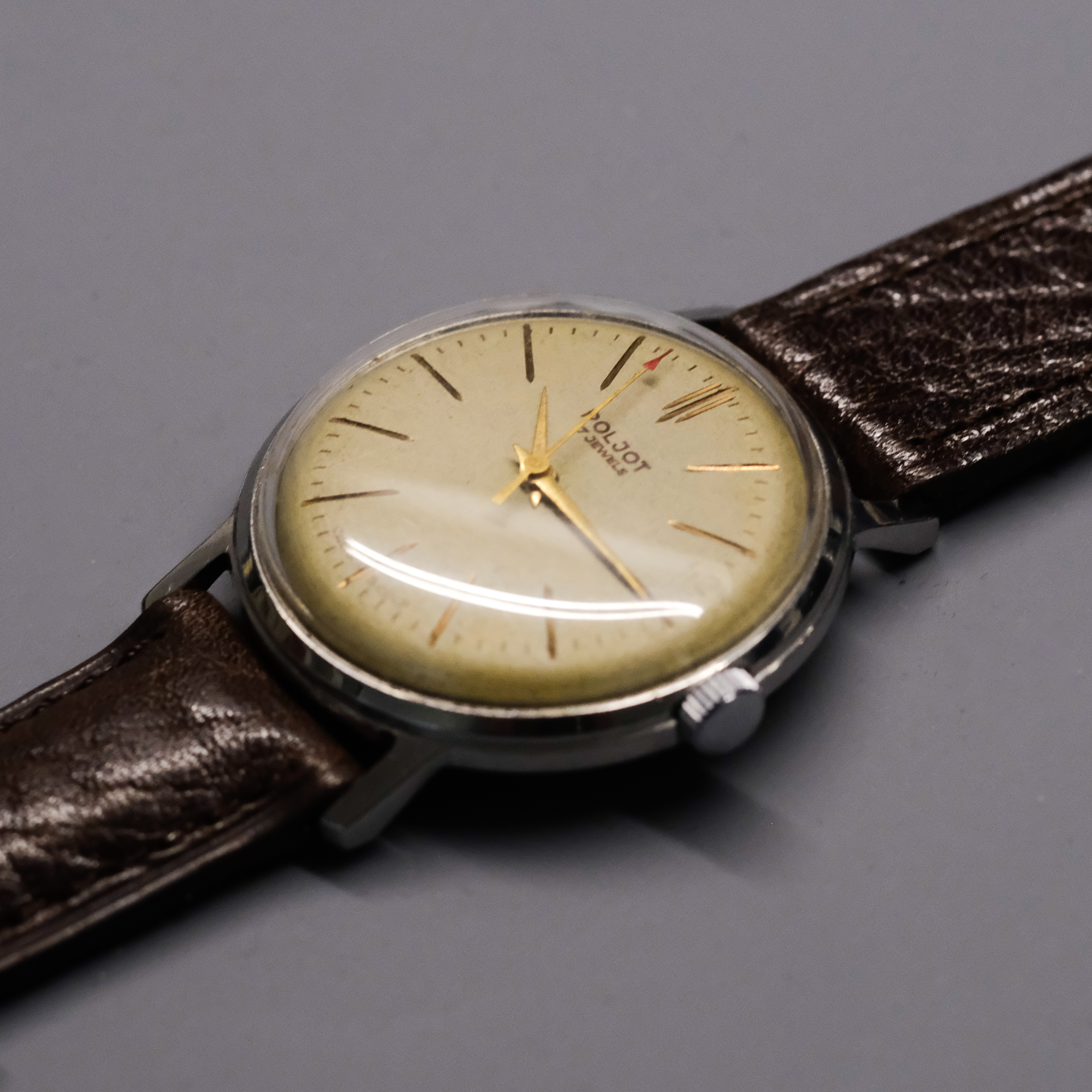
To celebrate Gagarin’s achievement, the First Moscow Watch Factory was renamed Poljot (Полёт), which literally means “flight” in Russian. It wasn’t a casual choice: the name encapsulated everything the USSR wanted to project to the world — technological innovation, space conquest, victory in the race against the West.
From that moment on, Poljot became the public face of quality Soviet watchmaking. Its watches would equip Air Force pilots, Northern Fleet sailors, and space program cosmonauts.
Sturmanskie vs. Poljot: The Confusion That Persists
A recurring question among collectors: Did Gagarin wear a Sturmanskie or a Poljot?
The answer requires understanding the difference:
- Sturmanskie (Штурманские) is the model name, derived from “штурман” (navigator). It was introduced in 1954 as a special-issue watch for Soviet Air Force pilots.
- Poljot is the brand and factory name that produced it.
In other words: Gagarin wore a Sturmanskie produced by Poljot. It’s like saying someone wears a Submariner produced by Rolex — the model and the brand are different things.
Gagarin’s Watch Specifications:
FeatureDetailModelSturmanskie Type 2Caliber43M (17 jewels)Diameter33 mmMaterialChrome-plated brassCrystalAcrylicPower reserve~34 hoursSpecial functionHack (seconds stopping)
Gagarin’s original watch is preserved today at the Museum of Cosmonautics in Moscow, where it’s one of the most visited pieces
Strela: The Chronograph of the First Spacewalk
If the Sturmanskie was the watch of the first flight, the Strela (”Arrow”) was the chronograph that accompanied cosmonauts when they stepped outside the capsule.
On March 18, 1965, Alexei Leonov became the first human to perform a spacewalk (EVA). For 12 minutes he floated in the void, connected to Voskhod 2 by an umbilical cable. On his wrist: a Strela chronograph with caliber 3017.
The conditions were brutal: temperatures swinging between -150°C and +150°C, absolute vacuum, cosmic radiation. The Strela performed flawlessly.
Why? Mechanical movements don’t depend on electronics or batteries. Energy stored in the mainspring is released through gears, and gravity is irrelevant to their operation. With a sealed case acting as a pressurized capsule, the watch maintained its internal atmosphere while Leonov floated in nothingness.
The 3133 Caliber: Swiss Technology with a Russian Soul
In the mid-1970s, Poljot made a technological leap that would define its legacy.
Swiss company Valjoux was discontinuing its 7734 caliber, replacing it with the new automatic 7750. Rather than discard the machinery, they sold the production tools to the USSR.
Poljot took those blueprints and created their own movement: the 3133 caliber, introduced in 1974. The improvements over the Swiss original were significant:
FeatureValjoux 7734Poljot 3133Jewels1723Frequency18,000 vph21,600 vphShock protectionIncabloc (standard)Proprietary Soviet systemChronograph gearsBronze/plasticAll jeweled
The 3133 would power the legendary Okean chronographs for the Soviet Navy, models never sold to the public that today command prices of €1,000-2,000 in the collector’s market.
Why They Were So Robust
Soviet watches weren’t designed for display cases. They were designed to survive.
The philosophy was radically different from Swiss luxury watchmaking:
- Generous tolerances: Thicker bridges and plates, sacrificing thinness for shock resistance.
- Extreme testing: Each watch underwent 10 days of timekeeping tests at three different temperatures (0°C, 20°C, 40°C).
- Special lubricants: Designed to function in Arctic cold or desert heat.
- No aesthetic compromise: Beauty was secondary; function was primary.
The result: watches that, 50 or 60 years later, continue to function with minimal maintenance. In collecting forums, it’s common to find testimonials of Sturmankies inherited from grandfathers that never stopped keeping time.
The Elegance of the Essential
There’s something profoundly honest about a Soviet watch.
It doesn’t pretend to be what it’s not. It carries no set diamonds or precious metals. It has no unnecessary complications or luxury marketing behind it. It’s a machine designed to function in the most extreme conditions imaginable — and it kept that promise while cosmonauts floated above our heads.
In an era where watches have become status symbols more than precision instruments, there’s something refreshing about returning to the source. In valuing an object for what it does, not for what it socially represents.
Gagarin’s Sturmanskie wasn’t elegant in the conventional sense. But there was elegance in its simplicity, in its robustness, in its ability to keep functioning when everything else would have failed.
That’s the elegance we seek to rescue at KLASSE: that of objects with purpose, with history, with soul.
Gagarin’s 108 minutes ended over six decades ago. The watch that marked them keeps beating.
Cartas sobre relojería, de tanto en tanto.
Sin spam. Baja cuando quieras. Privacidad.