

The Watch That Flew Over the World: Universal Genève and the Polerouter Odyssey
Copenhagen, November 15, 1954
The cabin of the Scandinavian Airlines Douglas DC-6B smells of new leather and kerosene. The captain adjusts his seat while observing, through the curved windshield, the gray runway of Kastrup Airport. In twenty-four hours, this aircraft will establish a new commercial route flying over the North Pole, connecting Copenhagen to Los Angeles in an impossible arc that will save 2,600 kilometers of distance. It is the inaugural transpolar flight, the civilian conquest of aviation’s last virgin territory.
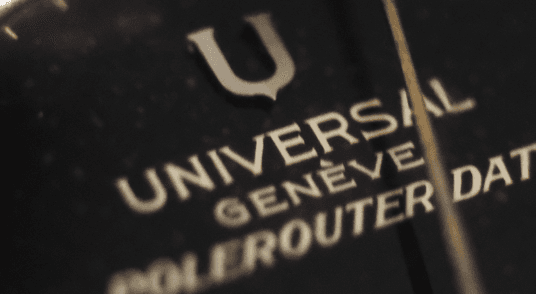
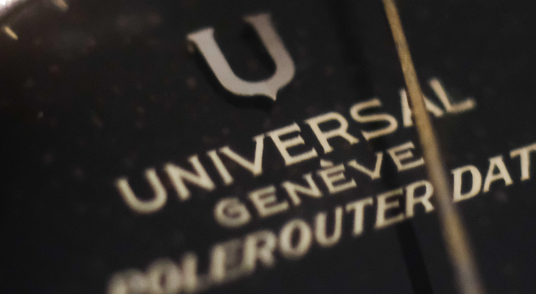
On the captain’s wrist, a newly delivered watch reads 08:47. Its white dial, almost Arctic in its purity, bears the inscription “Universal Genève” in thin letters. The hands, black as India ink, advance over applied indices that seem designed to be legible even when the polar sun blinds the cabin or the Arctic night envelops everything. The watch doesn’t have a definitive name yet—some call it Polarouter, others Polerouter—but it has been created specifically for this moment: to survive the extreme magnetism of the pole, resist temperatures that will oscillate between -40°C and +40°C in a single flight, maintain precision when all other instruments fail.
What no one knows that November morning is that this watch, designed by a 23-year-old named Gérald Genta, will not only measure the hours over polar ice. It will define an aesthetic language that will resonate in watchmaking for the next seven decades.
The Discreet House of Geneva
To understand how a Swiss watch ended up flying over the North Pole, one must go back sixty years, to 1894, when Numa-Émile Descombes and Ulysse Georges Perret, two classmates from the Le Locle chronometry school, decided to found Universal Watch. They didn’t intend to compete with the great Geneva houses. Their ambition was more modest and more profound: to manufacture movements of absolute precision for a world that was beginning to move faster.
When Descombes died prematurely in 1897, Perret continued alone, obsessed with miniaturization and complication. In 1919, he moved the manufacture to Geneva, renaming it Universal Genève, and began producing what connoisseurs would call “the traveler’s watchmaking”: chronographs that measured speeds, 24-hour watches for those crossing time zones, automatics that charged with arm movement during long journeys.
The golden age arrived in the thirties. Universal Genève launched the Compax series: chronographs so precise they eclipsed Rolex, so elegant they competed with Patek Philippe. The 1944 Tri-Compax—with day, date, month, moon phases, and chronograph—was a mechanical symphony contained in 35 millimeters. The Aero-Compax, with its full hour counter instead of the usual 30 or 45 minutes, became the watch of postwar civilian pilots.
But the true stroke of genius would come in 1955, when Universal Genève presented caliber 215: the first truly functional micro-rotor. Instead of placing the automatic rotor above the movement—increasing thickness—they integrated it within the same plane as the caliber. At only 4.1 millimeters thick, it was the world’s thinnest automatic movement. An engineering marvel that allowed creating elegant watches without sacrificing automatic winding.
The Polar Commission
When SAS contacted Universal Genève in 1954, the challenge was clear: they needed a watch that would survive conditions no civilian watch had ever faced. The North Pole wasn’t just extreme cold; it was a vortex of magnetism where compasses went mad and instruments failed. It was humidity that froze instantly, constant fuselage vibrations, pressure changes that could shatter poorly sealed crystals.
Universal Genève turned to an almost unknown designer: Gérald Genta, a young man from Geneva who had shown talent for translating technical specifications into elegant forms. Genta didn’t design a conventional aviation watch. He created something new: a steel case with curved lugs reminiscent of a lyre, a domed profile that distributed pressure evenly, a clean dial that rejected any superfluous decoration. It was a watch that could be worn in a DC-6B cockpit as easily as at dinner at the Ritz.
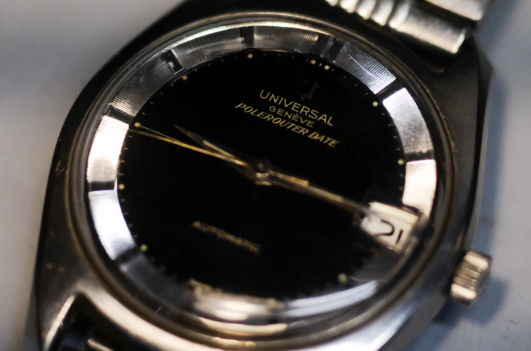
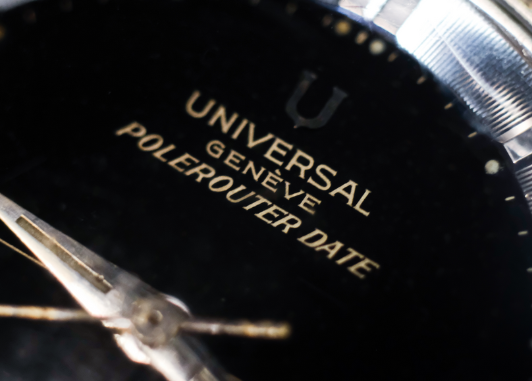
The Polerouter—a name that finally prevailed over Polarouter for phonetic reasons—synthesized two worlds. It had the robustness of a professional instrument but the elegance of a dress watch. Its curved acrylic crystal captured light hypnotically, creating reflections that seemed like miniaturized aurora borealis. The dial, available in snow white, deep black, or warm champagne, changed personality depending on the viewing angle.
The Silent Revolution of the Micro-Rotor
When Universal Genève updated the Polerouter with caliber 215 in 1955, the watch transformed into something more than an aviation instrument. The micro-rotor, visible through the crystal caseback on some models, was a mechanical marvel: a small gold segment that rotated eccentrically within the movement, charging the mainspring with every wrist gesture. It was pure efficiency, mechanical elegance reduced to its essence.
Collectors of the era didn’t immediately understand the revolution it represented. While other brands boasted large, heavy rotors, Universal Genève had created an almost invisible but tremendously efficient system. The micro-rotor allowed the Polerouter to maintain a slim profile—less than 10 millimeters total thickness—without sacrificing the 48-hour power reserve.
Variants proliferated during the sixties. The Polerouter Jet, with its black dial that aged to acquire “tropical” chocolate tones, became the favorite of commercial pilots. The Polerouter Date added a date window at three o’clock, a practical concession for executives living between airports. The Polerouter Super, launched in 1965 with 300-meter water resistance, took the original design into sportier territory, with a prominent crown and straight lugs that anticipated the aesthetic Genta would use a decade later in the Royal Oak.
The Designer Who Defined an Era
It’s impossible to understand the Polerouter without understanding what Genta achieved at 23. In an era when aviation watches were purely functional instruments—black dials, large numbers, no aesthetic pretensions—Genta created something that transcended categories. The lyre-shaped lugs weren’t just elegant; they distributed weight so the watch sat perfectly on any wrist. The thin bezel maximized dial area without increasing case size. Every decision was simultaneously aesthetic and functional.
Twenty years later, when Audemars Piguet commissioned him to design a steel sports watch, Genta would remember the Polerouter’s lessons. The 1972 Royal Oak shared with the Polerouter that indefinable quality: the ability to be elegant without being delicate, robust without being crude. A year later, Patek Philippe’s Nautilus would repeat the formula. The three watches—Polerouter, Royal Oak, Nautilus—form a trinity of modern design, united by the vision of a man who understood that true luxury doesn’t need to shout.
The Twilight of a Legend
The quartz crisis of the seventies hit Universal Genève with particular cruelty. A brand built on mechanical excellence, revolutionary micro-rotors, and complex chronographs had no answers for a quartz crystal that vibrated 32,768 times per second and cost pennies to produce. Between 1970 and 1983, while the Swiss watch industry lost two-thirds of its companies and employees, Universal Genève agonized in silence.
The sale to Stelux Group in 1989 was less a rescue than a burial with honors. For the next three decades, Universal Genève existed as a ghost: a brand with glorious history but no present, an archive of patents and designs that no one knew how to resurrect. Relaunch attempts in 2006 failed. The brand that had competed with Patek Philippe was reduced to an after-sales service in Geneva, attending to the increasingly rare Polerouters that arrived for maintenance.
The Frozen Dream
In December 2023, Breitling announced the acquisition of Universal Genève for an estimated sum of 70 million euros. Georges Kern, CEO of Breitling, promised to respect the legacy while building a future. The first signs came in October 2024: three commemorative Polerouters for the 70th anniversary of the transpolar flight, manufactured with a modernized caliber but faithful to the original micro-rotor.
But resurrecting a legend isn’t just a matter of capital and technology. Universal Genève represents a watchmaking philosophy—precision without ostentation, innovation without fanfare—that seems anachronistic in a world of 45-millimeter watches and digital complications. The Polerouter, with its modest 35 millimeters and clean dial, is a whisper in a conversation dominated by shouts.
Collectors searching for vintage Polerouters at auctions and secondary markets aren’t just buying a watch. They’re acquiring a fragment of an era when flying over the North Pole was an adventure, when watches were designed to last generations, when a young designer could create an icon without knowing it. Every surviving Polerouter—especially the rare SAS with the airline logo, or the Jets with tropicalized dials—is a testament to when Switzerland didn’t just measure time but defined it.
Epilogue: Circular Time
Today, when transpolar flights are routine and pilots trust GPS more than chronometers, the Polerouter seems an artifact from another era. But there’s something eternal in its design, something that transcends its original function. It’s a watch born to connect continents that now connects generations: the grandfather who bought it in 1960 in Zurich, the father who inherited it without understanding its value, the grandson who rediscovers it in a drawer and suddenly comprehends that he holds something irreplaceable in his hands.
The micro-rotor keeps turning, silently charging the mainspring with every wrist movement. It needs no battery, requires no software updates, doesn’t become obsolete. It’s pure mechanics, time converted into gears and rubies, precision translated into steel and crystal.
Universal Genève no longer takes flight, but the Polerouter continues traveling, guided by a micro-rotor that still dreams of polar skies.
Cartas sobre relojería, de tanto en tanto.
Sin spam. Baja cuando quieras. Privacidad.