

The Suspended Second: The Silent History of Switzerland’s Most Public Clock
Zürich Hauptbahnhof, February, 7:58 AM
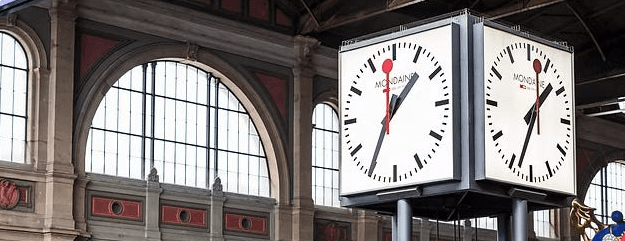
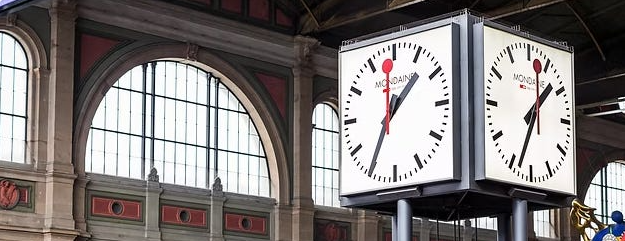
Platform three is covered with a fine layer of snow that the morning’s first travelers have turned into gray paths. Above them, suspended from the wrought iron structure dating from 1871, a white clock observes. Its face, the size of a wagon wheel, has no numbers. Only black lines, thick as beams, mark the hours. The hands, also black, advance with the certainty of those who know their destiny. But it’s the red second hand—a scarlet disc with a round dot at its tip—that hypnotizes anyone who watches it long enough.
Fifty-eight and a half seconds it takes to complete its circuit. Then, just before reaching twelve, it stops. A second and a half of absolute pause, as if time itself needed to catch its breath. In that suspended instant, all the clocks in all the stations of Switzerland—from Geneva to St. Moritz, from Basel to Lugano—wait together. An electrical pulse travels from a central master clock, and in unison, thousands of minute hands advance. The red second hand resumes its circular march. Swiss time, perfectly synchronized, continues.
This ritual of collective precision occurs 1,440 times a day, 525,600 times a year, since 1944. It’s the world’s most-watched and least-noticed temporal choreography.
The Engineer Who Drew Time
Hans Hilfiker wasn’t a watchmaker. He was a railway engineer, a man from Zurich who since 1932 had worked for the Swiss Federal Railways (SBB) solving practical problems: signaling, schedules, passenger flows. In 1944, while Europe bled, Hilfiker received a seemingly minor commission: design a standard clock for Swiss stations that would be legible, uniform, and reliable.
The problem was more complex than it appeared. Each station had its own clock, its own style, its own interpretation of time. Passengers changing trains in Bern could find three minutes’ difference between the platform clock and the vestibule clock. For a country that based its reputation on railway punctuality, it was a silent scandal.
Hilfiker, working with manufacturer Moser-Baer, created something radical in its simplicity. He eliminated everything superfluous: the numbers, the decorations, the elaborate typography. Only the essential remained: a face white as paper, indices black as India ink, hands that couldn’t be confused. It was Bauhaus applied to public time, a visual declaration that in Switzerland, time needs no adornment to be precise.
In 1953 he added the final touch: a red second hand inspired by the signaling paddle that station masters used to dispatch trains. That scarlet disc didn’t just measure seconds; it was a visual nod to the design’s railway origins, a reminder that this clock didn’t exist to adorn wrists but to synchronize a nation in motion.
The Invisible Architecture of Swiss Time
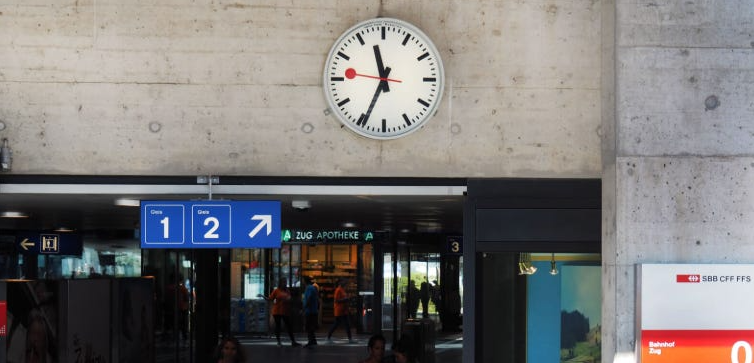
What Hilfiker created transcends industrial design. It’s an architecture of shared time. Each SBB clock is a terminal connected to a central nervous system: the master clock that from some anonymous bunker in Bern dictates Switzerland’s official time. There’s no drift, no interpretation. When the second hand stops below twelve, it’s awaiting orders. When it resumes its march, it does so in unison with thousands of other red second hands throughout the country.
This synchronization isn’t just technical; it’s cultural. In a country of four official languages, twenty-six cantons, and profound regional differences, the SBB clock is one of the few truly national symbols. A German-speaking Bernese and a French-speaking Genevan might not understand each other speaking, but both know exactly what time it is when they look at that white disc on the station wall.
For decades, the SBB clock was invisible from being seen so much. It was in stations, schools, post offices, hospitals. It was the clock you consulted without thinking, the one that defined whether you were late for work or caught the last train home. It was pure infrastructure, as omnipresent as asphalt or traffic lights.
Mondaine: When Public Became Personal
In 1986, something changed. Mondaine, a Swiss watch company founded in 1951 by Erwin Bernheim that had survived the quartz crisis by remaining family-owned and independent, obtained from SBB the license to produce wristwatch versions of the station clock. It was an audacious proposition: taking an object of urban furniture and reducing it to the size of a personal accessory.
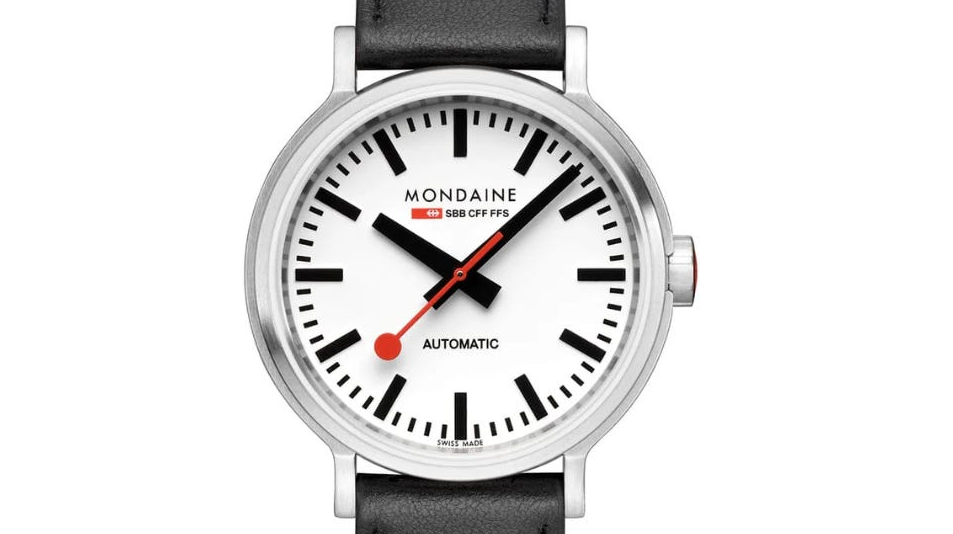
The translation wasn’t literal but spiritual. Mondaine maintained every element of Hilfiker’s design: the immaculate white face, the monumental black indices, the sober hands, and above all, the red second hand. In the most sophisticated versions, they even reproduced the characteristic behavior: the “stop2go” models advance 58 seconds, stop, and resume their march, as if the wearer’s wrist were another station in the Swiss railway network.
What Mondaine understood is that they weren’t selling a watch but a fragment of national identity. Wearing a Mondaine SBB on your wrist was declaring an affiliation not just aesthetic but philosophical: believing in clarity over ornamentation, in function over form, in collective precision over individual expression. It was, in a way, wearing Switzerland on your wrist.
The Red Disc That Became Poetry
The SBB/Mondaine red second hand is unique in watchmaking. It’s not a hand but a disc, with a white dot at its tip that seems like an eye observing the passage of time. Its movement—that continuous advance followed by a meditative pause—transforms the mechanical measurement of time into something almost respiratory. It’s as if the watch inhales for 58 seconds and exhales in that second and a half of stillness.
This technical gesture, born from the necessity of railway synchronization, has become a visual signature so powerful that when Apple copied it without permission in 2012 for their clock application in iOS 6, the technological world discovered that even absolute simplicity has an owner. SBB and Mondaine sued, and Apple—the company that had turned minimalism into corporate religion—had to pay more than 20 million dollars for the right to use a design that any child could draw but only a Swiss could have conceived.
The Paradox of Permanence
In 2024, when smart watches measure not just time but heartbeats, steps taken, and calories burned, Mondaine continues producing essentially the same watch Hilfiker designed eighty years ago. The company has innovated—their Essence line uses sustainable materials like castor oil and recycled PET—but the design remains untouched. It’s the same white disc, the same black lines, the same red second hand stopping before continuing.
This permanence isn’t nostalgia but declaration. In a world accelerated to hysteria, where time is measured in nanoseconds and notifications fragment every moment, the Mondaine SBB proposes a different temporality. It’s not a watch for those in a hurry but for those who understand that true precision isn’t about running faster but knowing when to stop.
Architects wear it because it speaks their visual language. Designers collect it because it’s a lesson in essential reduction. The Swiss give it to foreigners like sharing a national secret. Tourists buy it at Zurich airport like taking home a fragment of Helvetic order.
Time as Public Service
What Hans Hilfiker understood in 1944, and what Mondaine has preserved since 1986, is that time can be a public service, not just a private possession. The SBB clock doesn’t tell you your time but our time. It doesn’t measure your day but everyone’s day. In its perfect synchronization there’s a subtle political proposition: that we can, if we want, move in unison without losing individuality.
Every time the red second hand stops, it’s reminding us that even time needs pauses, that absolute continuity is an illusion, that advancing sometimes requires stopping to synchronize with others. It’s a lesson that Switzerland, small and multilingual, surrounded by powers and greater histories, learned centuries ago: survival isn’t in speed but in coordination.
Epilogue: The Necessary Second
In Zurich station, as I write these lines on a November afternoon, I observe the platform clock. It’s 16:47 and 42 seconds. The red disc advances implacably toward its appointment with the pause. 50 seconds. 55. 58. It stops.
In that suspended second and a half, all of Switzerland breathes in unison. The trains wait. The passengers watch. Time, for an instant, doesn’t pass: it simply is. Then, with the inevitability of mountains and glaciers, the minute hand advances, the second hand resumes its orbit, and the world continues.
Switzerland’s most precise clock isn’t the one that never fails; it’s the one that allows itself to stop for a second before advancing. In that pause lies all the wisdom of a country that understood that time, like trains, works better when we all wait together for the exact moment to depart.
Cartas sobre relojería, de tanto en tanto.
Sin spam. Baja cuando quieras. Privacidad.